_1771415502.png)
FPO Sustainability in India: From Survival to Self-Reliant Growth
India’s agricultural future is closely tied to the strength of its small and marginal farmers, who constitute nearly 86% of total farm holdings. In this context, farmer collectivization is no longer optional but a structural necessity. (Mukherjee et al., 2019)Farmer Producer Organizations (FPOs) were introduced to address persistent challenges such as fragmented landholdings, weak bargaining power, and limited market access. With strong policy support, particularly under the 10,000 FPO scheme of the Government of India, the number of FPOs has expanded rapidly across the country (Anand et al., 2023a).
Despite this growth, sustainability remains a major concern. Although more than 8,800 FPOs are registered in India, studies indicate that only 16–30% are sustainably functional (Mukherjee et al., 2025). This reality has been underscored in a 2025 study published in Current Science by researchers from the ICAR-Research Complex for Eastern Region and collaborating institutions. The key challenge, therefore, is not the formation of FPOs, but their ability to survive and grow beyond the initial project phase.
Evidence from research and field experience shows that sustainable FPOs are those that consistently create value for their members through effective governance, professional management, diversified business activities, and strong market linkages (Anand et al., 2025). Long-term viability depends on moving from grant dependence to member-driven, market-oriented operations. Drawing on empirical studies, extension research, private sector experience, and the Grassroots Organizational Ecosystem Model, this blog examines how FPOs can transition from mere survival to self-reliant and resilient farmer enterprises in India (Mukherjee et al., 2025).
Why FPO Sustainability Matters More Than Ever
FPOs were envisioned as instruments of empowerment for smallholders helping them aggregate produce, access inputs collectively, negotiate better prices, participate in value chains, and ultimately secure more stable incomes. When these organizations mature, the impact is visible and meaningful. Studies across India (Mukherjee et al., 2018a; Anand et al., 2023) consistently show that well-functioning FPOs improve farmer incomes, reduce transaction costs, and enhance overall member welfare.
Yet the journey from formation to maturity is far from smooth. Most early-stage FPOs struggle with low paid-up capital, weak member participation, and a heavy dependence on subsidies. Limited market intelligence, inadequate business planning, and governance gaps further constrain their growth. As a result, many FPOs exist in name but fail to generate real value for their members (Mukherjee et al., 2019a).
This is why sustainability matters more than numbers. True sustainability demands a shift in mindset-from viewing FPOs as scheme-driven entities to nurturing them as enterprises embedded within a supportive ecosystem. Only when farmers, markets, finance, and institutions work together can FPOs move beyond survival and become resilient, member-owned engines of rural growth (Mukherjee et al., 2019).
Framework for FPOs Sustainability
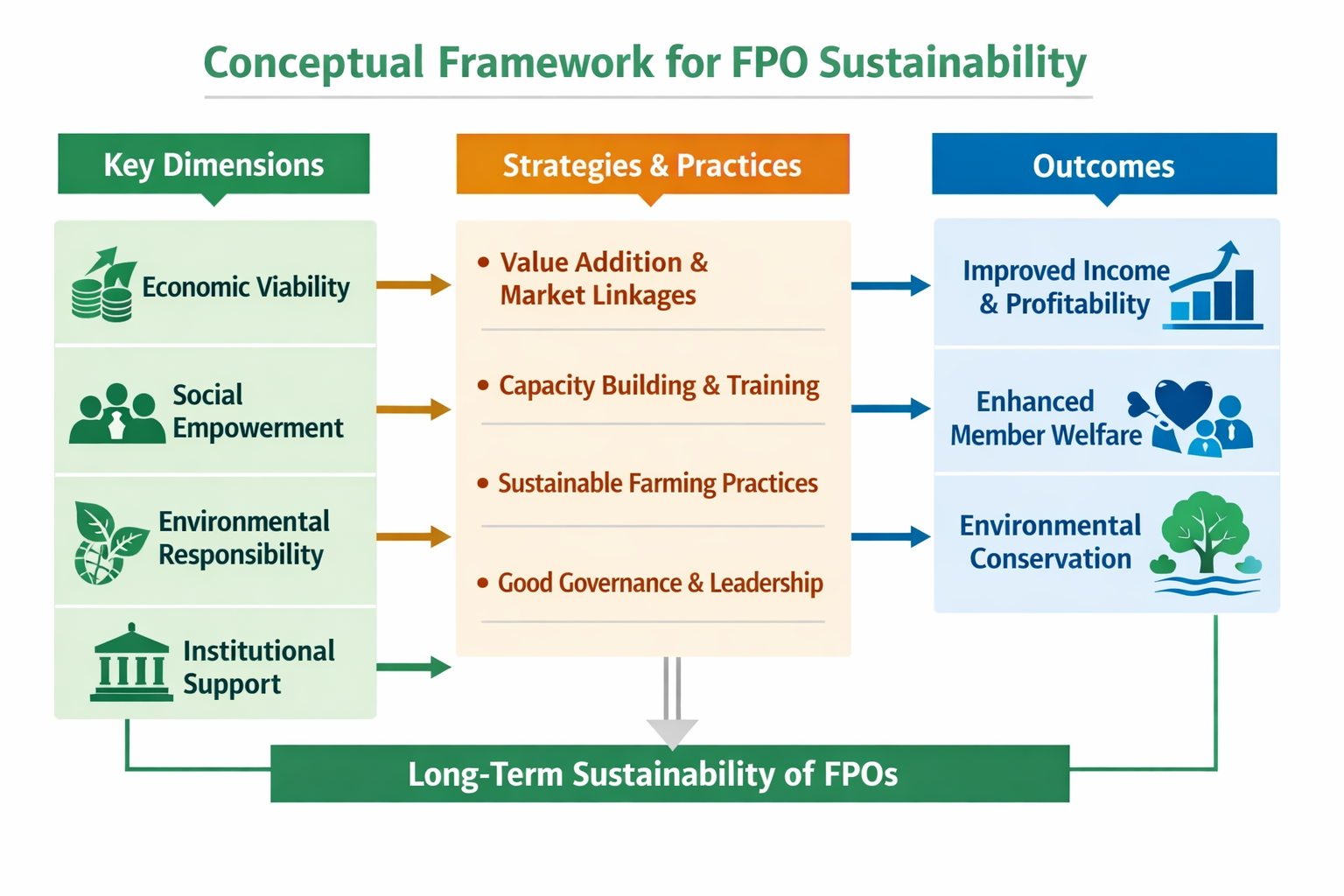
The sustainability framework highlights four strategic pillars that enable FPOs to move from short-term survival to long-term, self-reliant growth.
Key Dimensions of Sustainable FPOs:
Economic viability is fundamental to the survival and growth of FPOs. Studies have shown that FPOs with diversified business activities, strong market orientation, and efficient financial management are more likely to sustain operations beyond the initial support phase (Anand et al., 2025). Economic viability enables FPOs to invest in infrastructure, provide member services, and reduce dependence on external subsidies.
Social empowerment reflects the collective strength of members and their ability to participate meaningfully in organizational processes. FPOs serve as platforms for leadership development, collective learning, and social inclusion. Evidence indicates that participation in FPOs enhances farmers’ confidence, decision-making ability, and social status, particularly among women and smallholders (Mukherjee, Singh, & Kumar, 2020). Social cohesion and trust among members are critical for sustaining collective action over time.
Environmental responsibility has gained prominence as concerns around resource degradation and climate vulnerability intensify. Sustainable agricultural practices promoted through FPOs such as balanced input use, soil health management, and eco-friendly production systems help ensure long-term productivity while protecting natural resources. Environmental stewardship is increasingly recognised as integral to the economic resilience of farmer collectives.
Institutional support plays a catalytic role in enabling FPO sustainability. Linkages with government agencies, financial institutions, research organizations, and private sector actors provide access to credit, technology, training, and markets. Public–private partnerships in agricultural extension have been shown to enhance service delivery efficiency and innovation, thereby strengthening farmer institutions like FPOs (Mukherjee & Maity, 2015; Mukherjee & Bahal, 2011).
Strategies and Practices: Operationalising Sustainability
The transformation of these foundational dimensions into tangible outcomes depends on effective strategies and practices adopted by FPOs.
Value addition and market linkages are central to improving farmer incomes. Research underlines that FPOs aligned with localized production strengths—such as the One District One Product (ODOP) approach—are better positioned to access niche markets and improve price realization (Anand, Ghosh, & Mukherjee, 2023a). Activities like grading, processing, branding, and direct marketing reduce dependency on intermediaries and enhance value capture at the farmer level.
Capacity building and training strengthen both individual and organizational capabilities. Training interventions improve farmers’ technical knowledge, managerial skills, and adoption of improved practices, which in turn contribute to higher productivity and organizational effectiveness (Mukherjee et al., 2021; Mukherjee et al., 2018). Continuous capacity development is particularly critical in the early years of FPO functioning.
Sustainable farming practices ensure that productivity gains are not short-lived. Promotion of climate-resilient practices, integrated nutrient and pest management, and diversification helps mitigate production risks and enhances long-term farm sustainability. Such practices also align FPO objectives with broader environmental and food security goals.
Good governance and leadership underpin the effective functioning of FPOs. Transparent systems, accountable leadership, and democratic decision-making foster trust among members and reduce internal conflicts. Studies highlight that weak governance structures are a major constraint affecting the sustainability of farmer collectives, whereas strong grassroots leadership enhances resilience and adaptability (Mukherjee et al., 2025).
Outcomes: Economic, Social, and Environmental Gains
When these strategies are implemented effectively, FPOs generate outcomes that extend beyond immediate financial returns.
Improved income and profitability are among the most visible outcomes of successful FPOs. Collective input procurement, efficient marketing, and value addition contribute to higher net returns for members and improved financial stability at the organizational level (Anand et al., 2025; Mukherjee et al., 2020).
Enhanced member welfare reflects improvements in livelihoods, social security, and overall well-being. Participation in FPOs has been associated with better access to advisory services, training, and information, including digital and mobile-based agro-advisories that support informed decision-making (Atheequlla et al., 2021). These benefits contribute to reduced vulnerability and stronger rural communities.
Environmental conservation emerges as a long-term outcome of responsible production practices. Improved soil health, efficient water use, and reduced chemical dependence contribute to sustainable agricultural landscapes that support future generations of farmers.
The Eight-Component Grassroots Ecosystem Model
Our study study published in Current Science in 2025 proposes the Eight-Component Grassroots Ecosystem Model to explain FPO sustainability through a holistic, systems-based lens. The model emphasizes that FPOs are embedded within a wider ecosystem, and their long-term viability depends on how effectively these eight components interact and reinforce one another.
Market
Markets determine whether FPOs survive or stagnate. Reliable market access, price transparency, buyer networks, and value-chain integration enable FPOs to move beyond aggregation toward profitable enterprise operations (Mukherjee et al., 2018). Strong market linkages incentivize member participation and ensure steady revenue flows.
Policy
An enabling policy environment provides the foundation for FPO growth. Supportive regulations, simplified compliance, performance-based incentives, and continuity beyond scheme cycles help FPOs plan for the long term. Policies must encourage enterprise behavior rather than perpetual dependence (Mukherjee et al., 2025).
Infrastructure
Physical infrastructure such as storage, warehouses, cold chains, processing units, and transport directly affects FPO efficiency and bargaining power. Inadequate infrastructure often leads to post-harvest losses and distress sales, undermining farmer confidence and profitability.
Services
Access to quality services, including extension, business advisory, accounting, legal support, and certification, strengthens FPO operations. Converged public and private service delivery improves outreach, reduces duplication, and enhances operational efficiency.
Inputs
Timely access to quality inputs-seeds, fertilizers, feed, and agrochemicals at competitive prices is a core member incentive. Collective input procurement reduces costs, ensures quality assurance, and strengthens member trust in the FPO.
Human Resource Development
People drive institutions. Skilled leaders, trained boards, and competent managers are essential for governance, business planning, and market engagement. Continuous capacity building transforms farmers into informed shareholders and leaders into strategic decision-makers.
Finance
Adequate and affordable finance remains a critical constraint. Access to working capital, credit, equity, insurance, and tailored financial products enables FPOs to scale operations, absorb shocks, and invest in value addition without excessive risk.
Innovation
Innovation technological, institutional, and managerial keeps FPOs competitive. Digital advisory services, ICT platforms, new business models, and climate-smart practices improve efficiency, transparency, and resilience in a rapidly changing agri-food system. Together, these eight components underline a central message: FPO sustainability cannot be built in silos. Long-term success depends on coordinated action and convergence among public extension systems, private advisory services, financial institutions, and market actors working as an integrated ecosystem rather than fragmented interventions.
From Subsidy Orientation to Enterprise Orientation
One of the most consistent findings emerging across more than three decades of empirical work on FPO performance is unmistakable: subsidy-driven FPOs tend to stagnate, whereas market-driven FPOs are more likely to sustain and grow over time. Government support plays an essential role during the formative stages of FPO development, particularly in farmer mobilization, institution building, and basic capacity enhancement. However, evidence suggests that prolonged dependence on subsidies often weakens commercial discipline, limits innovation, and undermines organizational autonomy (Mukherjee et al., 2019a; Anand et al., 2025).Long-term viability instead hinges on an FPO’s ability to mobilize internal capital, diversify its business portfolio, and foster meaningful member equity participation. Studies show that FPOs with higher levels of member ownership and financial contribution exhibit stronger governance, greater accountability, and improved resilience to external shocks (Mukherjee et al., 2018; Mukherjee et al., 2018b). Enterprise-oriented FPOs are also more likely to invest in value addition, input services, and market-linked activities, thereby reducing reliance on external grants (Mukherjee et al., 2018; Anand et al., 2023).Strategic partnerships with agribusiness firms, service providers, and financial institutions further reinforce enterprise orientation by improving access to technology, markets, and professional expertise. Evidence from public–private partnership models demonstrates that such collaborations enhance operational efficiency, reduce institutional dependency, and enable convergence of extension, finance, and market services (Mukherjee & Maity, 2015; Mukherjee et al., 2012). Over time, these partnerships help FPOs transition from scheme-dependent entities into self-reliant commercial organizations embedded within competitive value chains (Mukherjee et al., 2025).
Taken together, the literature clearly indicates that while public support is necessary to initiate collectivization, enterprise thinking, internal capital formation, and market-linked partnerships ultimately determine the sustainability and growth trajectory of FPOs.
From Local Mandi to Global Market Orientation
A parallel and equally robust insight emerging from the growing body of FPO literature is that FPOs confined to local mandi–centric operations tend to encounter structural growth ceilings, whereas those oriented toward diversified and distant markets demonstrate greater resilience and scalability. Heavy dependence on nearby mandis exposes FPOs to price volatility, weak bargaining power, and spatially constrained demand conditions. Although local markets remain important during the early stages for liquidity, quick turnover, and risk buffering, long-term competitiveness increasingly depends on an FPO’s ability to integrate with regional, national, and international value chains (Mukherjee et al., 2019a; Anand et al., 2025). The transition toward broader market orientation requires systematic investments in aggregation infrastructure, grading and standardization, quality assurance, and market intelligence systems. Empirical studies consistently show that FPOs engaging in direct procurement arrangements, institutional buyers, organized retail chains, and processor-linked or export-oriented channels achieve superior price realization and greater income stability for their members (Mukherjee et al., 2018; Anand et al., 2023a). The use of digital platforms, traceability mechanisms, and ICT-enabled advisory services further supports this shift by reducing information asymmetry and enabling compliance with food safety and phytosanitary standards (Roy et al., 2018; Atheequlla et al., 2021). Evidence from export-linked, commodity-focused, and processor-integrated FPO models suggests that global and extra-local market orientation not only enhances revenue streams but also catalyzes organizational learning, professional management practices, and product diversification. Such exposure encourages FPOs to adopt formal quality protocols, improve governance systems, and strengthen internal coordination (Mukherjee & Maity, 2015; Mukherjee et al., 2025). By moving beyond the confines of local mandis and strategically positioning themselves within higher-value markets, FPOs gradually transform from price takers into value creators, thereby reinforcing their long-term economic sustainability, institutional credibility, and member confidence.
From Self-Consumption to Market-Preference Orientation
A recurring insight across empirical studies on farmer collectivization is that production systems dominated by self-consumption objectives tend to constrain income growth, whereas market-preference–oriented production creates pathways for sustained economic advancement. While subsistence and semi-subsistence production systems play an essential role in ensuring household food security especially in risk-prone and resource-constrained contexts they often result in fragmented marketable surplus, inconsistent quality, and weak engagement with organized markets (Mukherjee et al., 2018; Anand et al., 2023). In contrast, a deliberate shift toward market-preference orientation aligns production decisions with demand signals, consumer preferences, and price incentives, thereby strengthening the commercial viability of farmer collectives.This transition requires moving beyond the traditional “produce-first, sell-later” approach toward demand-driven production planning, where crop choice, varietal selection, harvest scheduling, and post-harvest handling are guided by market intelligence. Empirical evidence shows that FPOs facilitating collective decision-making on production calendars, quality standards, and input use are better able to meet buyer specifications and access remunerative markets (Anand et al., 2023a; Mukherjee et al., 2019a). Market-oriented production also promotes specialization, economies of scale, and adoption of improved technologies, leading to higher productivity and surplus generation (Mukherjee et al., 2018; Anand et al., 2025).
Market-preference orientation strengthens the commercial identity of farmers, transforming them from passive sellers of residual output into strategic actors within value chains. Studies consistently demonstrate that when farmers clearly perceive market demand, price differentiation, and quality premiums, their willingness to invest, adopt innovations, and participate in collective marketing increases significantly (Mukherjee et al., 2018b; Mukherjee et al., 2021). Digital and mobile-based advisory services further support this transition by improving access to timely market and production information, enhancing farmers’ responsiveness to changing market conditions (Atheequlla et al., 2021; Roy et al., 2018).
Thus, the shift from self-consumption to market-preference orientation is not merely a behavioral adjustment at the farm level, but a deeper structural transition that underpins the economic sustainability, growth trajectory, and long-term relevance of Farmer Producer Organizations. When embedded within supportive institutional ecosystems and market linkages, this transition enables FPOs to evolve from subsistence-oriented collectives into resilient, market-integrated farmer enterprises (Mukherjee & Maity, 2015; Mukherjee et al., 2025).
Outcomes of Sustainable FPOs
When economic, social, environmental, and institutional dimensions align with sound strategies, the outcomes of sustainable FPOs become clearly visible. These organizations generate higher and more stable incomes, improve profitability, and enhance overall member welfare. Beyond economic gains, sustainable FPOs contribute to environmental conservation through better resource management and climate-smart practices, while also strengthening local rural economies. Empirical studies (Roy et al., 2018; Anand et al., 2023) confirm that mature FPOs successfully move beyond primary aggregation into secondary agriculture, processing, branding, and deeper value-chain integration, creating long-term value for farmers.
The Road Ahead
The next phase of FPO development in India calls for reflection as much as expansion. After a decade of rapid formation, it is increasingly clear that the strength of farmer collectivization will be measured not by how many FPOs exist, but by how many truly work. Many FPOs today struggle not because farmers lack intent, but because the institutional ecosystem around them remains thin, fragmented, and short-term in its support.
Going forward, policy must place people before paperwork. Professional managers, trusted field-level facilitators, and committed board members are not optional add-ons; they are the backbone of sustainable FPOs. Long-term access to working capital without excessive collateral or procedural complexity is equally critical if FPOs are to function as real enterprises rather than project entities. Digital tools, when thoughtfully integrated, can reduce information asymmetry, improve transparency, and help farmers make more confident production and marketing decisions.
Policy frameworks therefore need to evolve from a “formation-first” mindset to one that rewards performance, learning, and resilience. Institutions such as the Small Farmers’ Agribusiness Consortium and the National Bank for Agriculture and Rural Development have already laid important foundations, but future policy must encourage deeper convergence between public extension systems, private advisory services, financial institutions, and markets. Ultimately, the success of FPOs will depend on whether farmers experience them not as schemes, but as trustworthy, farmer-owned institutions that grow alongside their aspirations.
The experience of Farmer Producer Organizations (FPOs) in India offers an important lesson for policymakers, practitioners, and farmer leaders alike: creating large numbers of organizations is only the first step in a much longer journey. Registration and initial support may bring FPOs into existence, but survival and success depend on whether these organizations can truly stand on their own feet. An FPO becomes meaningful only when it consistently serves its members, earns their trust, and grows as a viable economic enterprise rather than remaining a project-dependent entity.
At the heart of FPO sustainability lie people and institutions. Strong and ethical leadership, transparent governance systems, and active member participation are not abstract ideals; they determine day-to-day functioning and long-term credibility. When farmers feel a sense of ownership through equity participation, regular engagement, and visible benefits they are far more likely to remain committed. Equally critical is the ability of FPOs to read and respond to markets. Organizations that understand demand, quality requirements, and price dynamics are better positioned to move from being price takers to value creators.
This blog emphasizes that FPO performance is shaped by a broader and interconnected ecosystem. Access to reliable markets, affordable finance, physical infrastructure, skilled human resources, and timely advisory services together influence outcomes. These elements do not operate in silos; weakness in any one area can place strain on the entire organization. The Eight-Component Grassroots Ecosystem Model helps explain why isolated interventions often fail and why coordinated support across institutions is essential for long-term success. Looking ahead, the national focus must shift decisively from forming more FPOs to strengthening those that already exist**. Professional management support, especially beyond the initial handholding period, is vital to build business discipline and strategic direction. Improved access to working capital—through flexible, FPO-friendly financial products can unlock growth and reduce dependence on informal credit. Thoughtfully integrated digital advisory services can enhance transparency, improve decision-making, and expand market access.
FPOs must transition from a mindset of subsidy dependence to one of enterprise orientation. Government schemes and public support remain important, but they should act as enablers rather than crutches. When FPOs begin to see themselves as farmer-owned businesses with long-term visions, they gain resilience. Such organizations not only improve farmer incomes but also strengthen collective confidence, deepen rural institutions, and contribute meaningfully to sustainable and inclusive rural development in India.
Reference
Anand, S., Ghosh, S., & Mukherjee, A. (2023). Effectiveness of farmer producer organizations (FPOs) at different growth stages in transitioning to secondary agriculture. Indian Journal of Extension Education, 59(3), 90–96.
Anand, S., Ghosh, S., & Mukherjee, A. (2023a). Strategies for strengthening farmer producer organizations in India based on the One District One Product scheme. Current Science, 125(6), 614-622.
Anand, S., Ghosh, S., & Mukherjee, A. (2025). How sustainable are the farmer producer companies (FPCs) in India? Annals of Public and Cooperative Economics.
Atheequlla, G. A., Mukherjee, A., Roy, M. L., & Chandra, N. (2021). Mobile based agro-advisory service and farmers’ willingness to pay. Journal of Community Mobilization and Sustainable Development, 16(3), 976–986.
Mukherjee, A., & Bahal, R. (2011). Effectiveness of Tata Kisan Sansar in technology advisory and delivery services in Uttar Pradesh. Indian Research Journal of Extension Education, 11(3), 8–13.
Mukherjee, A., & Maity, A. (2015). Public–private partnership for convergence of extension services in Indian agriculture. Current Science, 109(9), 1557–1563.
Mukherjee, A., & Maity, A. (2015). Public–private partnership for convergence of extension services in Indian agriculture. Current Science, 109(9), 1557–1563.
Mukherjee, A., Bahal, R., Burman, R. R., Dubey, S. K., & Jha, G. K. (2012). Constraints in privatised agricultural technology delivery system of Tata Kisan Sansar. Journal of Global Communication, 5(2), 155–159.
Mukherjee, A., Roy, M. L., Joshi, P., Jethi, R., & Chandra, N. (2021). Impact assessment of farmer training on scaling up of vegetable productivity. Indian Journal of Extension Education, 57(2), 1–7.
Mukherjee, A., Roy, S., Pradhan, K., & Yadav, V. K. (2025). Current challenges and solutions for sustainability of farmers producer organisations through grassroots organisational ecosystem. Current Science, 128(7), 699–709.
Mukherjee, A., Singh, P., & Kumar, S. A. U. (2020c). Women empowerment through farmers producers organization. Food and Scientific Reports, 1(2), 9–14.
Mukherjee, A., Singh, P., Burman, R. R., & Shubha, K. (2018c). Development of test to measure knowledge level of FPO members. Journal of Community Mobilization and Sustainable Development, 14(1), 57–64.
Mukherjee, A., Singh, P., Maity, A., & Burman, R. R. (2020b). Enhancing livelihood security of dairy farmers through farmer producer company. Range Management and Agroforestry, 41(1), 156–167.
Mukherjee, A., Singh, P., Rakshit, S., & Burman, R. R. (2018b). Development and standardization of scale to measure farmer’s attitude towards farmers’ producer company. Indian Journal of Extension Education, 54(4), 84–90.
Mukherjee, A., Singh, P., Rakshit, S., Priya, S., Burman, R. R., & Shubha, K. (2019). Effectiveness of poultry based Farmers’ Producer Organization and its impact on livelihood enhancement of rural women. Indian Journal of Animal Sciences, 89(10), 1152–1160.
Mukherjee, A., Singh, P., Ray, M., Satyapriya, & Burman, R. R. (2018). Enhancing farmers’ income through farmers’ producer companies in India: Status and roadmap. Indian Journal of Agricultural Sciences, 88(8), 1151–1161.
Mukherjee, A., Singh, P., Shubha, K., & Burman, R. R. (2019a). Facilitating and hindering factors affecting growth and functioning of farmer producer companies. Indian Journal of Extension Education, 55(4), 14–20.
Rakshit, S. et al. (2025). Empowerment of Rural Women and Youth Retention as Drivers of the Agricultural Economy. In: Sharma, N.K., Rai, P.K., Rai, D.C. (eds) Indian Agriculture: Challenges, Priorities and Solutions. Springer, Singapore.
Roy, M. L., Chandra, N., Mukherjee, A., Jethi, R., & Joshi, K. (2018). Extent of use of ICT tools by hill farmers and associated social factors. Indian Research Journal of Extension Education, 18(3), 27–31.
Mukherjee, A., Singh, P., Rakshit, S. S., & Burman, R. R. (2018c). Development and standardization of scale to measure farmer’s attitude towards farmers’ producer Company. Indian Journal of Extension Education, 54(4), 84-90.
Tags :
COMMENTS (0)