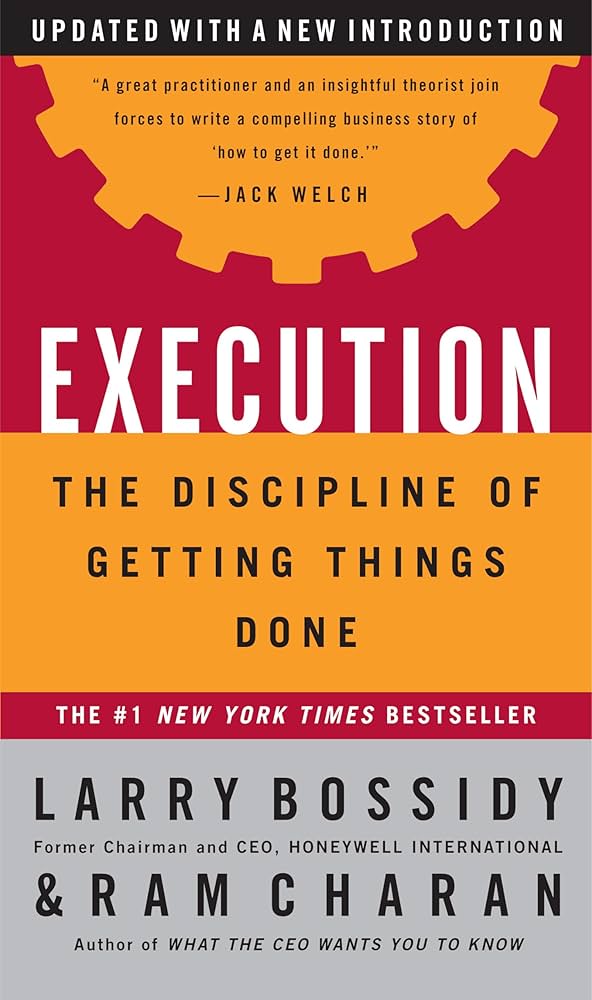
Execution: The Discipline of Getting Things Done Book Review
Execution: The Discipline of Getting Things Done
Larry Bossidy and Ram Charan (2002)
Crown Business, New York
“Unless you translate big thoughts into concrete steps for consecutive actions, they are pointless”
In the world of business and entrepreneurship, the people with bold ideas, disruptive strategies, and innovative thinking are often celebrated. Larry Bossidy and Ram Charan’s Execution: The Discipline of Getting Things Done challenges this popular narrative. The book argues that success is not the result of brilliant ideas alone. Instead, it comes from something far less glamorous but far more powerful: disciplined execution.
Rather than romanticizing leadership, the authors present a serious reality. Vision, strategy, and innovation matter, but without consistent follow-through, they remain little more than aspirations. Execution, they insist, is not a secondary managerial function delegated to others; it is the very core of leadership itself—the missing link between goals and results. For entrepreneurs especially, this message feels both practical and uncomfortable. Many founders thrive on creativity and big thinking but struggle with implementation. Organizations frequently assume that once the “thinking” is complete, the “doing” will naturally follow. Authors question this assumption. A strategy only matters if leaders can ground it in operational reality through questioning, accountability, and continuous follow-up.
Execution as a Discipline, not a Task
One of the book’s most compelling arguments is that execution is not a collection of management techniques but a disciplined system. It involves rigorously defining how things will be accomplished, asking tough questions, monitoring progress, and ensuring accountability at every level. Importantly, the authors distinguish execution from micromanagement. Effective leaders do not control every detail; instead, they create clarity. Everyone in the organization understands what needs to be done, why it matters, and how success will be measured. Leaders remain connected to operational realities rather than observing from a distant “visionary” position. Execution, therefore, becomes embedded in culture rather than treated as an afterthought.
The Three Core Processes of Execution
The authors organize execution around three interconnected processes: People, Strategy, and Operations.
1. The People Process
The authors make a simple but powerful claim: organizations do not execute strategies—people do. Selecting, developing, and positioning the right individuals is the most critical leadership responsibility. This process goes far beyond traditional human resources practices. Leaders must honestly assess talent and possess the emotional strength to make difficult decisions when roles and capabilities do not align. Strong execution depends on capable, energized individuals who can sustain momentum, particularly during uncertainty.
2. The Strategy Process
A brilliant strategy that cannot be executed is ultimately useless. The strategy process translates broad vision into concrete actions grounded in market realities and organizational capabilities. Startups often rush toward innovation without building executable plans. The book reminds readers that sustainable success requires breaking the “big idea” into clear, sequential steps. Strategy must live in practical decisions, not just presentations or mission statements.
3. The Operations Process
The operations process provides the path for the people to follow the strategy. It is the discipline of ensuring that commitments are met, resources are managed efficiently, and progress is tracked rigorously. This process demands a focus on closure—the habit of reviewing commitments and ensuring they are completed. Without this systematic monitoring, initiatives that begin with enthusiasm often fade away, creating an illusion of progress through meetings and announcements without achieving tangible results.
Culture Begins with Dialogue and Realism
Execution is ultimately sustained by organizational culture, particularly through honest dialogue and realism. The authors argue that culture is shaped less by slogans and more by everyday conversations. In high-performing organizations, dialogue is candid, fact-based, and open to challenge. Difficult questions are encouraged rather than avoided. This insight is especially valuable for entrepreneurs. Culture is not built through motivational posters or corporate values statements—it emerges from how people communicate daily. When conversations allow truth to surface, collective intelligence improves decision-making.
Realism requires leaders to see situations as they truly are, not as they hope them to be. Many organizations fail because leaders cling to optimism while ignoring warning signs. Execution demands intellectual honesty—the willingness to confront weaknesses, accept market feedback, and make tough decisions quickly. For founders emotionally invested in their ideas, this may be one of the hardest disciplines to master.
Leadership Qualities That Drive Execution
Beyond systems and processes, authors highlight the personal qualities leaders must develop.
· Strategic Focus
Effective leaders concentrate on a small number of priorities—typically three or four critical goals. This disciplined focus prevents organizations from scattering energy across too many initiatives. Simplicity, the authors argue, is not a limitation but a leadership strength.
· Emotional Fortitude
Execution requires character as much as competence. Authenticity, humility, self-awareness, and resilience enable leaders to accept criticism, acknowledge mistakes, and adapt without defensiveness.
· Leadership Presence
Execution cannot happen from a distance. Leaders must remain visibly engaged with their teams and operations. Their presence communicates priorities more clearly than formal directives ever could, reinforcing accountability and energizing employees and ensures that the organization`s intentions are being translated into daily action.
A Book with Universal Relevance
Although the book draws heavily from case studies of large corporations such as Honeywell and GE, its lessons apply equally to startups, small teams, and entrepreneurial ventures. In fact, execution may matter even more in small scale enterprises where mistakes carry higher consequences. Founders often confuse involvement with control, but Execution reframes leadership as guiding priorities rather than stifling creativity. Success comes not from dreaming bigger but from consistently working through the details that transform ideas into outcomes.
The book stands out for its practical approach. Rather than offering abstract theories, authors present leadership as demanding, hands-on work grounded in accountability and action. The central message is that success does not belong to those with the best ideas, but to those who build organizations capable of turning ideas into reality. In a world overflowing with vision statements and ambitious plans, execution remains the true competitive advantage.
Ultimately, the book serves as a powerful reminder that meaningful change happens step by step. Leadership is not about inspiration alone; it is about ensuring that aspirations are translated into measurable results. Those who master execution are not simply dreamers—they are builders.
Sajesh V. K.
Dr Sajesh is working as Senior Scientist (Agricultural Extension) at ICAR-IISR, Kozhikode, Kerala, 673012
Tags :
COMMENTS (0)